

OSS Spay Surgery in Newport Beach

Elevating Care with Ovarian-Sparing Spay (OSS) Surgery
OSS spay surgery in Newport Beach, also called ovary sparing spay, removes the uterus while leaving the ovaries in place. Welcome to UrbanVet, where contemporary veterinary excellence converges with compassionate pet care. If you are considering spaying your female dog, it is worth understanding how this option differs from a traditional spay.
Expert Recommendations
Elevate Your Pet’s Health Journey
Discover UrbanVet, where veterinary excellence and genuine care unite to redefine pet wellness through OSS spay surgery. Join us in Newport Beach, CA, and give your pet a happy, healthy life. Contact us today to schedule an appointment.
Why Choose UrbanVet’s OSS Spay Surgery
We’re more than just a veterinary clinic; we’re a compassionate community dedicated to nurturing the special bond you share with your pet. Choosing UrbanVet for OSS spay surgery offers an array of benefits:
- Expertise and Innovation: Our team comprises skilled veterinarians who excel in OSS surgery. We combine the latest advancements with a deep understanding of pet emotion, ensuring your furry friend receives the best care possible.
- Personalized Approach: We take the time to know your pet, their personality, habits, and medical history. This allows us to recommend OSS spay surgery as part of a tailored wellness plan, reflecting our commitment to their individual needs.
- Trusted Partnership: As pet parents ourselves, we understand your concerns and aspirations. We’re here to answer questions, provide guidance, and support you every step of the way, fostering a partnership built on trust and shared dedication to your pet’s well-being. As pet parents, we understand your concerns and aspirations. We’re here to answer questions, provide guidance, and support you every step of the way, fostering a partnership built on trust and shared dedication to your pet’s well-being.
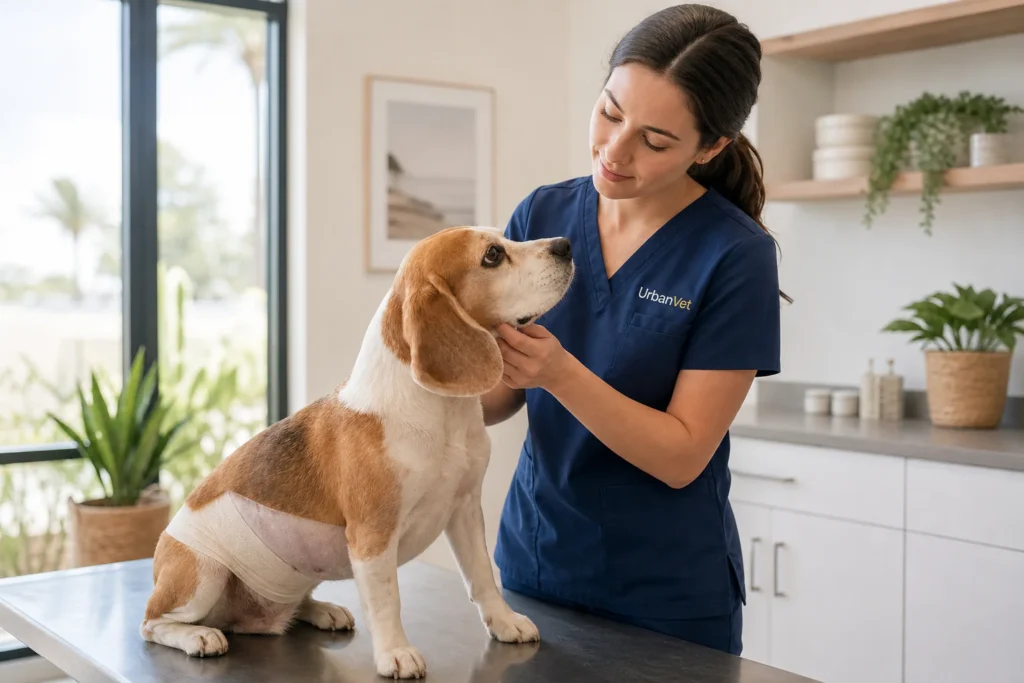
What OSS spay surgery in Newport Beach actually is
OSS stands for ovary sparing spay. The surgeon removes the entire uterus, including the cervix, and leaves one or both ovaries in place. A traditional spay, by contrast, is an ovariohysterectomy, which removes the ovaries and the uterus together. The two procedures are frequently confused and they produce genuinely different outcomes.
The reason owners ask for OSS is hormonal. Because the ovaries remain, the dog keeps her natural sex hormones, and a growing body of evidence links early removal of those hormones in some breeds to increased rates of cruciate ligament rupture, hip dysplasia and certain cancers. OSS is an attempt to prevent litters and pyometra without removing the endocrine function.
The trade offs, stated plainly
This is not a free upgrade and we will not present it as one. Because the ovaries stay, your dog will continue to cycle. She will show behavioural signs of heat and will attract intact males, though she will not bleed the way an intact bitch does, since there is no uterus. Owners who chose OSS expecting no heat behaviour are the ones who regret it.
She also retains a hormone driven mammary cancer risk that a conventional early spay reduces. And the surgery must remove the complete uterus including the cervix, because any remaining uterine tissue can develop stump pyometra. That makes it a more demanding procedure than a routine spay, which is exactly why it should be discussed rather than ordered off a menu.
Prevents litters, like a traditional spay
Prevents pyometra, provided the entire uterus and cervix are removed
Retains natural hormones, which some evidence links to joint and cancer outcomes
She will still cycle and still show heat behaviour
Does not reduce mammary cancer risk the way an early traditional spay does
A more technically demanding procedure than a routine spay
Deciding whether it fits your dog
OSS is most often chosen for large and giant breed dogs, working and sporting dogs, and owners specifically concerned about orthopedic outcomes. It is a poor fit for a household that cannot manage a dog in heat twice a year, and it is not usually the right answer for cats.
Come in and talk it through. We will give you the evidence as it currently stands, including where it is genuinely uncertain, and a recommendation for your specific dog rather than a general position. Join us in Newport Beach, CA and call (949) 520-7440 to schedule.
Living with a dog who still cycles
This is the practical reality of ovary sparing spay and it is worth rehearsing before you commit. Roughly twice a year your dog will come into season. She will not bleed, because the uterus is gone, but her behaviour and scent will change and intact males will know. Expect a few weeks of closer supervision, no off lead time in public, and no dog park or open beach access during that window.
For an owner who walks on lead and has a secure yard, this is a minor adjustment. For a household whose dog spends every weekend running free at the beach, it is a real constraint twice a year, every year, for the life of the dog. Be honest with yourself about which household you are.
We also recommend continuing to monitor the mammary chain, since hormone driven mammary tumour risk remains. Feel along both chains monthly and tell us about any new lump, however small. Most are benign. Finding them early is what keeps it that way.
What the OSS procedure involves
01
The OSS procedure is performed under general anesthesia with the same monitoring as any abdominal surgery here. The surgeon removes the entire uterus including the cervix and leaves one or both ovaries. Completeness is the whole point, because retained uterine tissue can develop stump pyometra later.
02
OSS surgery in a dog takes longer than a routine spay and demands more of the surgeon, which is why not every practice offers it. Recovery for an OSS dog follows the same rules as any spay: ten to fourteen days of restriction, no swimming, and the cone stays on.
03
Owners searching for OSS dog spay or for ovary sparing spay near me are usually already convinced of the hormonal argument. Our job is to make sure you also understand the trade offs, because a dog who still cycles is a commitment that lasts her whole life.
Booking a consultation
Ovary sparing spay is a decision worth making in the room rather than online. Call (949) 520-7440 to book a consultation and we will go through the current evidence, the trade offs and what we would recommend for your specific dog. We are at 1220 Bison Avenue, Unit A7, Newport Beach.
Frequently asked questions
No. A traditional spay is an ovariohysterectomy, removing ovaries and uterus together. Ovary sparing spay removes the entire uterus and cervix but leaves one or both ovaries, so your dog keeps her natural hormones.
Yes. She will cycle roughly twice a year and show heat behaviour, and intact males will respond to her, though she will not bleed because the uterus is gone. Owners who expect no heat behaviour after OSS are the ones who regret the choice.
Not if the entire uterus including the cervix is removed, which is why the surgery is more demanding than a routine spay. Retained uterine tissue can develop stump pyometra, so completeness is the whole game.
Most often large and giant breeds, working and sporting dogs, and owners specifically concerned about orthopedic outcomes. It is a poor fit for a household that cannot manage a dog in season twice a year, and it is not usually right for cats.